Off the Grid, Into the Void: Inside the Synth Communities the Algorithm Can't Find
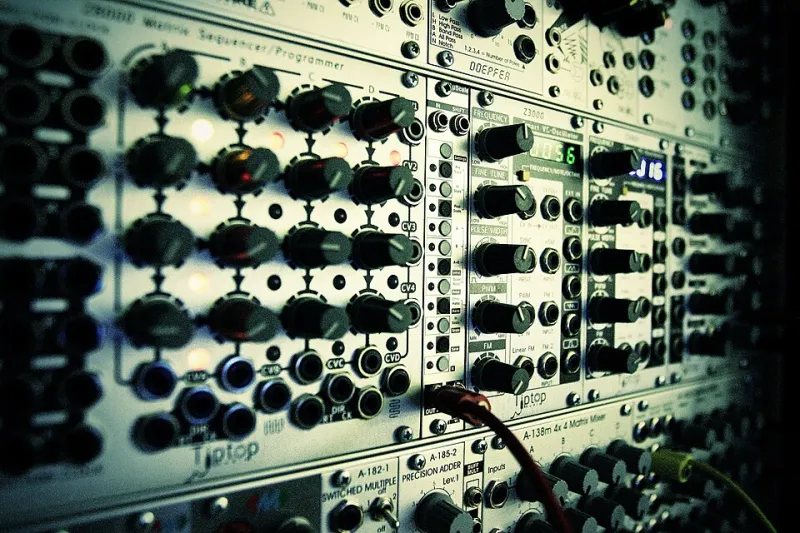
Photo: fr4dd, CC BY 2.0, via Wikimedia Commons
The server has no promotional graphics. The pinned message is a wall of text about patch-sharing etiquette. There are 340 members, and on any given Tuesday afternoon, maybe twelve of them are active — swapping oscillator recordings, arguing about the character of specific VCA chips, occasionally dropping a forty-minute drone piece with zero context into the #releases channel.
This is not a growth-hacked community. Nobody is running engagement campaigns. And the music coming out of it is genuinely strange and genuinely good in ways that almost nothing on any major playlist is.
This is where some of the most interesting electronic music in the US is actually happening.
The Playlist Problem
To understand why these communities exist the way they do, start with what they're not. Mainstream streaming infrastructure — Spotify, Apple Music, Amazon — is built around discoverability mechanics that reward specific things: consistent release cadences, genre legibility, track lengths that don't alienate casual listeners, sonic profiles that sit comfortably next to other tracks in an algorithmic radio station.
For producers making genuinely experimental synthesizer music, almost none of those conditions apply. A fifty-minute modular improvisation isn't going to slot into a Focus Flow playlist. A release that comes out whenever it's done, not on a content calendar, gets deprioritized. Music that doesn't sound like anything adjacent to it in the database confuses recommendation engines.
The result is that a whole tier of serious, technically sophisticated electronic music has effectively been priced out of the mainstream discovery ecosystem — not because nobody wants to hear it, but because the infrastructure wasn't designed with it in mind.
So the people making it went somewhere else.
Where They Actually Live
The geography of these communities is scattered and intentionally low-profile. Discord is the most common infrastructure right now — cheap to run, easy to organize with channels, and crucially, not indexed by search engines in any meaningful way. You find these servers through word of mouth, through someone dropping an invite link in a comment thread, through following the right Bandcamp accounts and noticing where the artists actually talk to each other.
Bandcamp itself functions as a kind of connective tissue. It's one of the few major platforms where a 73-minute ambient record gets the same real estate as a three-minute pop single, and where the artist keeps a meaningful cut of every sale. For experimental synth producers, it's less a discovery platform and more a distribution point — a place to put the work so that the people who already know about you can actually pay for it.
Beyond that, you've got private forums — some running on old phpBB infrastructure that looks like it hasn't been updated since 2009 — where producers share patches, techniques, and gear recommendations with a specificity and depth that no mainstream music publication covers. Elektronauts for the Elektron-heads. Lines for the more ambient and modular crowd. Muffwiggler (now ModWiggler) for the synthesis nerds who want to go very, very deep into analog circuitry.
And then there are the genuinely forgotten platforms. SoundCloud, which has been in various states of financial crisis for years, still hosts a massive underground of experimental electronic work precisely because nobody's really curating it anymore. The algorithm there is weak enough that you can still stumble onto something genuinely unexpected.
The Collaboration Model
What's interesting about how these communities actually function is that the work happens collectively in ways that don't map neatly onto traditional music industry models. Producers share half-finished patch ideas and invite others to build on them. Someone records a session with a broken piece of gear and posts the raw audio for anyone to sample. Compilation releases get assembled organically, with no label involvement, distributed through Bandcamp or handed out as free downloads via a shared Google Drive link.
This isn't just lo-fi indie ethics — it's a genuinely different production philosophy. When you're not optimizing for streams, you're not optimizing for hooks or for the three-minute mark where a casual listener decides whether to skip. You can let a piece develop at whatever pace it actually needs. You can make something that only works if the listener is paying close attention. You can collaborate with someone in a completely different timezone over the course of six months without any of it needing to resolve into a marketable product.
The output of this process tends to be music that sounds like it was made by people who were only thinking about the music. Which, in the current landscape, is genuinely rare.
The Cost of Staying Underground
None of this is without trade-offs, and the people in these communities are generally honest about that. Obscurity is real. Making experimental synthesizer music for a Discord server of a few hundred people does not pay rent in most American cities. The producers operating at this level tend to have day jobs, or teach, or survive on a patchwork of Bandcamp sales and Patreon support and occasional live sets at small venues.
There's also a legitimate tension around access. These communities can be hard to find if you don't already know where to look, which means they can end up being less diverse than they should be — shaped by who has the time, equipment, and existing connections to locate them. It's something the more self-aware corners of these scenes talk about openly, even if solutions are slow to materialize.
Why It Matters
Here's the thing about music that exists outside the recommendation engine: it has to survive entirely on the strength of what it actually is. There's no playlist placement carrying it. No algorithmic boost. No viral moment. If people keep coming back to a server, keep buying the Bandcamp releases, keep sharing the links — it's because the work is doing something for them that nothing else is.
That's a pretty pure signal. In a media environment full of noise, it's worth tuning into.