Signal Architects: 5 Producers Letting Machines Write the Music
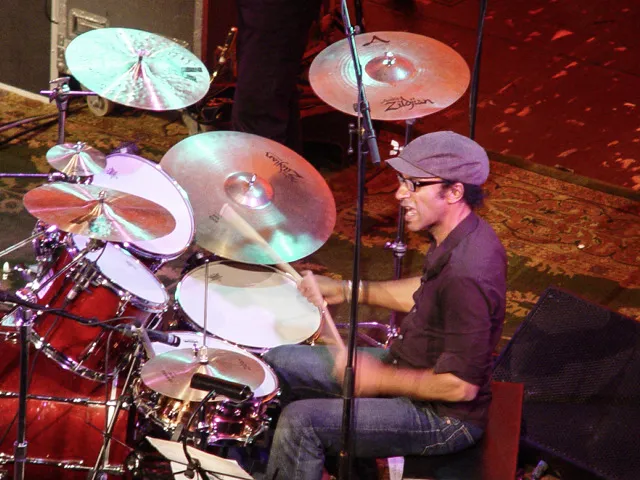
Photo: Hreinn Gudlaugsson, CC BY-SA 4.0, via Wikimedia Commons
Forget the debate about whether AI is going to replace musicians. That conversation is happening in boardrooms and op-ed pages, and it's mostly missing the point. In studios, bedrooms, and server farms across the country, a smaller and more interesting conversation is already in progress — and it sounds like nothing you've heard before.
These aren't producers who are worried about what AI means for the industry. They're the ones who grabbed the technology by the collar and asked it a question: what do you hear that I can't? The answers have been strange, disorienting, sometimes beautiful, and occasionally kind of unsettling. Here are five of them worth paying attention to.
1. Mara Solis — Training Neural Nets on Silence
Location: Chicago, IL
Tools: Custom Python scripts, Magenta, Ableton Live
Key track: Null Space (Extended) — available on her Bandcamp
Mara Solis doesn't feed her AI systems music. She feeds them the absence of it. Her process involves training neural networks on recordings of near-silence — empty rooms, the hum of electrical infrastructure, the ambient noise floor of different cities — and then prompting those models to "compose" within those parameters.
The results are micro-tonal, glacially slow, and completely hypnotic. Solis describes her work as "trying to hear what the machine thinks quiet sounds like." The compositions that come out of her sessions aren't generated in real time — she curates, edits, and layers the outputs over weeks, treating the AI as a collaborator with a very specific and alien sensibility.
"It doesn't know what music is supposed to do," she says. "It only knows what I showed it. If I show it silence, it builds structures around silence. Those structures are genuinely surprising to me every time."
Her sonic philosophy centers on the idea that most electronic music is still fundamentally human in its rhythmic and harmonic assumptions. The grid, the beat, the chord — all of it is legible to human ears because human ears built it. Solis wants to find the space outside that legibility.
2. Derek Osei — Algorithmic Polyrhythm and the Collapse of the Grid
Location: Atlanta, GA
Tools: Max/MSP, custom generative MIDI systems, Eurorack modular
Key track: Fractal Pulse Vol. 3 — released on a limited USB run
Derek Osei came up in Atlanta's bass music scene before deciding that the 4/4 grid was a cage he was done living in. His current work uses algorithmic MIDI generation — sequences built by code rather than by hand — to produce polyrhythmic structures that would be physically impossible for a single human producer to program note-by-note.
The system he's built in Max/MSP generates multiple independent rhythmic streams, each operating at different tempos and with different probability weights for note triggers. The streams interact with each other in real time, creating patterns that are structured enough to feel intentional but complex enough to feel alive.
"I'm not pressing play and walking away," Osei clarifies. "I'm the one who built the rules. But once the rules are running, the music is making decisions I didn't make. That's the part I'm interested in."
His modular setup adds another layer — the algorithmic MIDI output feeds into analog oscillators and filters that introduce their own instabilities. The machine is composing. The hardware is interpreting. Osei is somewhere in the middle, steering without controlling.
3. Yuki Tanaka-Reyes — Feeding Emotional Data Into Generative Systems
Location: Los Angeles, CA
Tools: Google's Magenta Studio, custom sentiment analysis pipelines, Logic Pro
Key track: Grief Index, April — streaming on SoundCloud
Yuki Tanaka-Reyes's approach is the most conceptually layered of the group. She builds pipelines that take text as input — journal entries, social media posts, transcripts of conversations — runs them through sentiment analysis models, and maps the emotional data outputs to musical parameters. Valence becomes harmonic brightness. Arousal becomes tempo. Dominance becomes dynamic range.
The result is music that's generated from emotional data rather than musical intention. Grief Index, April was built from three months of her own journal entries following a family loss. She didn't decide what notes to play. The data did.
"I wanted to take something I couldn't talk about directly and let a machine translate it into a form I could share," she explains. "The music isn't mine exactly. It's the system's reading of my experience. There's a distance there that makes it easier to put out into the world."
Tanaka-Reyes is careful to note that the outputs aren't finished tracks — they're starting points. She spends significant time shaping and arranging the generated material, but she commits to a rule: she never adds notes that weren't in the original output. She can remove. She can reorder. She can apply processing. But the composition itself is the machine's.
4. Callum Voss — Training on Defunct Formats and Dead Media
Location: Portland, OR
Tools: AudioCraft, custom training datasets, Reaper
Key track: 8-Track Eulogy — released on cassette through a Portland noise label
Callum Voss is obsessed with dead technology. His training datasets are built from digitized recordings of obsolete formats — 8-track cartridges, Laserdisc audio, AM radio broadcasts from the 1960s and '70s, early digital formats like CD+G. He trains generative audio models on these recordings and prompts them to produce new material that carries the sonic fingerprint of formats that no longer exist.
The music that comes out sounds like it's from a timeline that didn't happen. Familiar but wrong. Nostalgic for something you never experienced.
"Every format has a sound," Voss says. "The way an 8-track bleeds between channels. The way AM radio compresses the high end. Those aren't just artifacts — they're the sound of a specific moment in how humans decided to store and transmit music. I'm trying to resurrect those decisions in new contexts."
His work sits at the intersection of glitch art, archival practice, and generative music. He's less interested in what AI can invent than in what it can remember — and how it misremembers.
5. Priya Nair — Real-Time Collaborative Improvisation With Live Models
Location: New York, NY
Tools: Magenta RealTime, Ableton with Max for Live, custom latency management scripts
Key track: Duet for Human and Inference Engine — live recording on her website
Priya Nair performs live with AI. Not pre-generated AI output — actual real-time inference, running on a laptop beside her keyboard rig, listening to what she plays and responding in milliseconds. Her performances are genuinely improvised conversations between her musical decisions and the model's predictions.
The model she uses has been trained on Indian classical music, free jazz, and contemporary electronic — a deliberately incoherent dataset that produces responses that don't fit neatly into any tradition. When she plays a phrase, the model completes it according to its own strange logic. She responds to that. It responds to her response.
"It's the closest thing to playing with another musician who has completely alien taste," she says. "It doesn't have ego. It doesn't get tired. It doesn't have a bad night. But it also doesn't care about what I'm trying to do. I have to work with that indifference."
Nair's live sets are unrepeatable — the model's responses are probabilistic, meaning the same input never produces exactly the same output twice. She records every performance but rarely releases them, treating them as documentation of a specific moment of exchange rather than finished works.
The Bigger Picture
What connects these five artists isn't the technology — the tools vary wildly. It's the posture. All of them have made a deliberate choice to cede some control to a system and then pay close attention to what comes back. That's a different relationship to composition than most music production encourages, and it's producing genuinely new sounds.
None of them are making AI music in the way the discourse usually frames it — push a button, get a song. They're in deep, technical, time-intensive conversations with systems that have their own strange forms of knowledge. The output is collaborative in the truest sense: neither fully human nor fully machine, but something that couldn't exist without both.