The Art That Watches Back: When Algorithms Make You the Medium
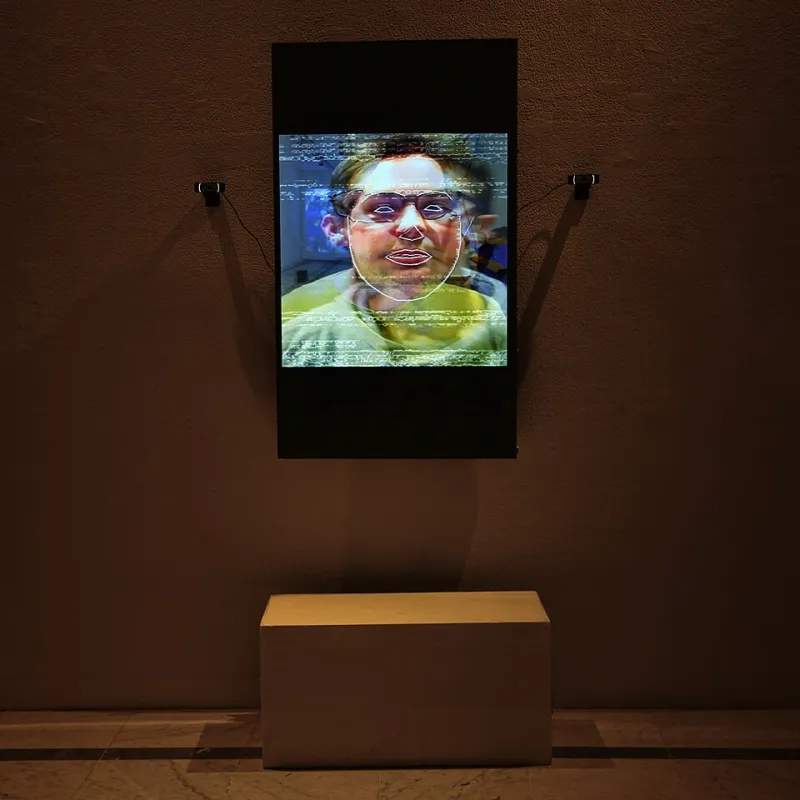
Photo: S.A.Tawil, CC BY-SA 4.0, via Wikimedia Commons
Walk into the wrong gallery these days and the painting might notice you walked in.
Not metaphorically. Literally. Cameras triangulating your position, sensors reading your movement speed, machine learning models inferring something about your attention or posture — and then, quietly, the work shifts. Colors migrate. Rhythms change. The thing you came to observe starts observing you back.
This is the territory that a growing number of artists are working in: generative and interactive pieces that aren't fixed objects so much as ongoing processes, ones that use real-time data about their audience to evolve in ways the artist didn't fully script. It raises questions that feel genuinely unresolved — about authorship, about surveillance, about what it even means to experience something versus participate in it.
The Loop Nobody Closes
The concept of feedback in art isn't new. Interactive installations have been a thing since at least the 1960s, when artists like Nam June Paik started wiring cameras to monitors and asking viewers to become part of the image. But the tools available now have changed what's possible in ways that feel qualitatively different, not just incrementally better.
Contemporary practitioners working in this space are using computer vision, physiological sensors, large language models, and custom-built neural networks to create what some of them call "responsive environments" — works that don't just react to input but actually model the people interacting with them. The distinction matters. Reaction is mechanical. Modeling implies something closer to interpretation.
Artist and coder Lauren McCarthy, whose work sits at the intersection of surveillance, intimacy, and software, has described her practice as being interested in "the gap between what technology promises and what it actually delivers in human terms." That gap is where most of the interesting work in this space lives.
When a piece starts using your behavior as data — your dwell time in front of a particular element, the speed at which you move through a space, whether you came back to look at something twice — it's not just responding to you. It's building a model of you. And then making art from that model. The feedback loop doesn't close. It compounds.
Authorship Gets Weird
One of the thornier questions this kind of work raises is who, exactly, made it. The artist designed the system. But the system's output is shaped by every person who passes through it. In a very real sense, the audience is co-authoring something they didn't intend to create and may not know exists.
Some artists lean into this explicitly. New York-based creative technologist Kyle McDonald has built pieces that aggregate anonymized behavioral data from thousands of interactions to generate visual outputs that no single viewer could produce alone. The work is a kind of emergent portrait of collective attention — made by everyone, owned by no one, controlled by an algorithm that the artist set in motion and then, in some ways, stepped back from.
This creates a strange relationship to intention. Traditional artistic practice involves a lot of decisions made in private, refined over time, presented as complete. Generative work that evolves with its audience doesn't have a final state. It's always mid-process. The artist's role shifts from author to architect — someone who designs the conditions under which something can happen, rather than the thing itself.
Not everyone is comfortable with that framing. Critics of this approach sometimes argue that it risks letting the artist off the hook — that "the algorithm did it" becomes a way to avoid responsibility for what the system produces. It's a fair concern, and one that the more thoughtful practitioners in this space tend to engage with directly rather than deflect.
Presence as Material
What's striking about the strongest work in this category is how it handles the ethics of watching. The best pieces don't obscure the fact that they're collecting data — they make that collection part of the experience, sometimes uncomfortably so.
Installations that display real-time visualizations of how they're tracking you, that change in ways that make your influence on the piece legible, that ask you to consent before entering a sensing zone — these choices aren't just ethical housekeeping. They're artistic decisions that shape how the work feels to move through.
There's something genuinely disorienting about standing in front of a piece and watching it respond to you in real time. The normal hierarchy collapses. You're not a passive receiver of the artist's vision. You're part of the system. Your presence is, in a technical and literal sense, the material the work is made of in that moment.
Some visitors find this exhilarating. Others find it invasive, even when they've agreed to participate. That tension — between the appeal of being seen and the discomfort of being read — is something the best artists in this space are actively trying to generate, not resolve.
Where the Human Ends
The deeper philosophical question these works keep circling is about the boundary between observer and observed, between the person and the data the person generates. In a culture already saturated with behavioral tracking, recommendation algorithms, and attention economics, art that makes those dynamics visible and strange feels less like novelty and more like necessity.
When a generative piece knows you're watching — and changes because of it — it's doing something that most of the systems shaping your daily digital life do constantly, but invisibly. Making it visible, making it aesthetic, making it something you stand in front of and feel something about: that's the move.
The void signal here isn't noise to be filtered out. It's the whole point. The gap between what you intended to communicate and what the system inferred — that's where the art lives.